In a first step we tried to obtain new halogenated derivatives with high reactivity in order to be able to use them later in the quaternization reactions with benzo[f]quinoline. All of this in order to obtain new compounds with antimicrobial and / or anticancer activity.
The first stage of synthesis involved an O-alkylation reaction of DHA and interesting behavior was noticed. Traces of a fluorescent compound were observed besides the two types of compounds obtained (bis-akylated DHA 2a–c and mono-akylated compounds 2a’–c’).
In order to improve the poor yields of bis-akylated DHA 2a–c, we modified the synthesis procedure by raising the temperature. Unfortunately, the yield in bis-akylated DHA 2a–c decreased, but, at the same time, the yield of fluorescent compound (which proved to be benzofuran ester derivative type 3) increased substantially, and at 165 _C total conversion was observed.
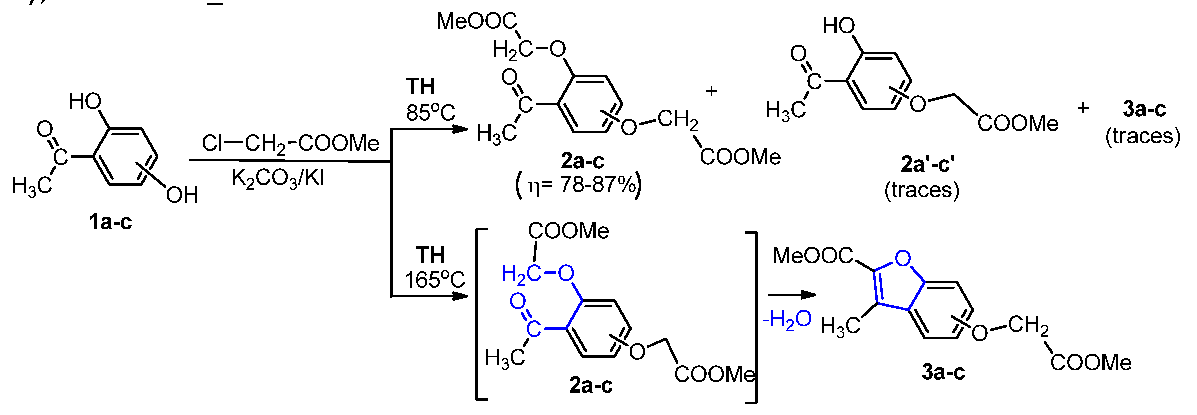
In contrast with conventional TH, when only one type of benzofuran derivative was obtained (3a–c), the MW-assisted reactions led either to a mixture of benzofuran derivatives, 3a–c and 4a–c, or to another type of benzofuran derivative (4a–c), according to the reaction time employed.
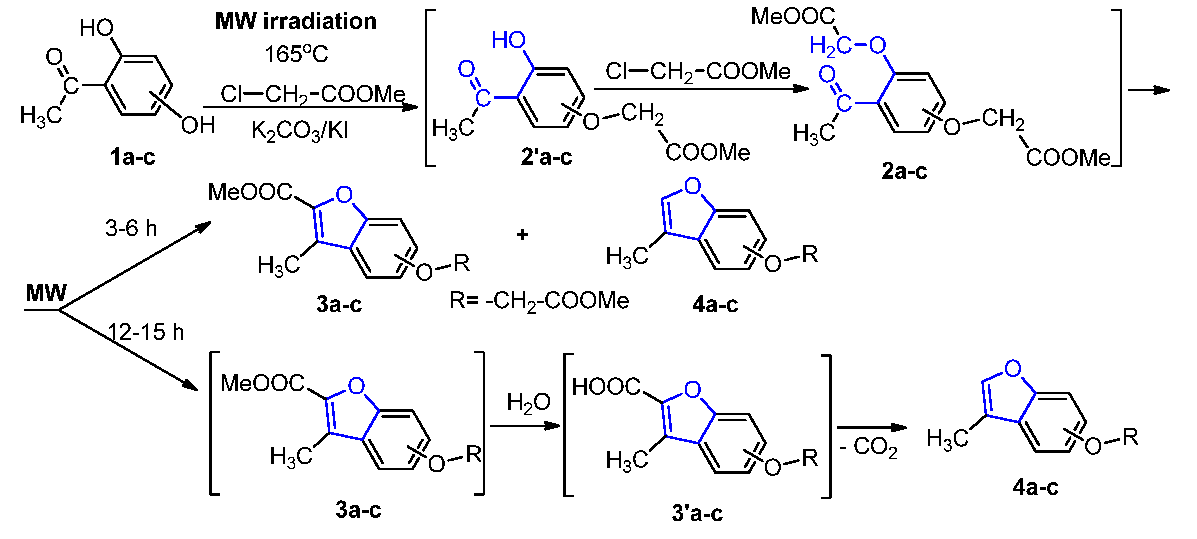
The best conditions used in thermal heating and MW irradiation are presented in Table 1. Under MW irradiation, the optimal reaction conditions were found to be at 165 °C, 17–19 bars.
Table 1. The optimized conditions for synthesis of benzofuran derivatives (3a–c or/and 4a–c), under MW and TH conditions.
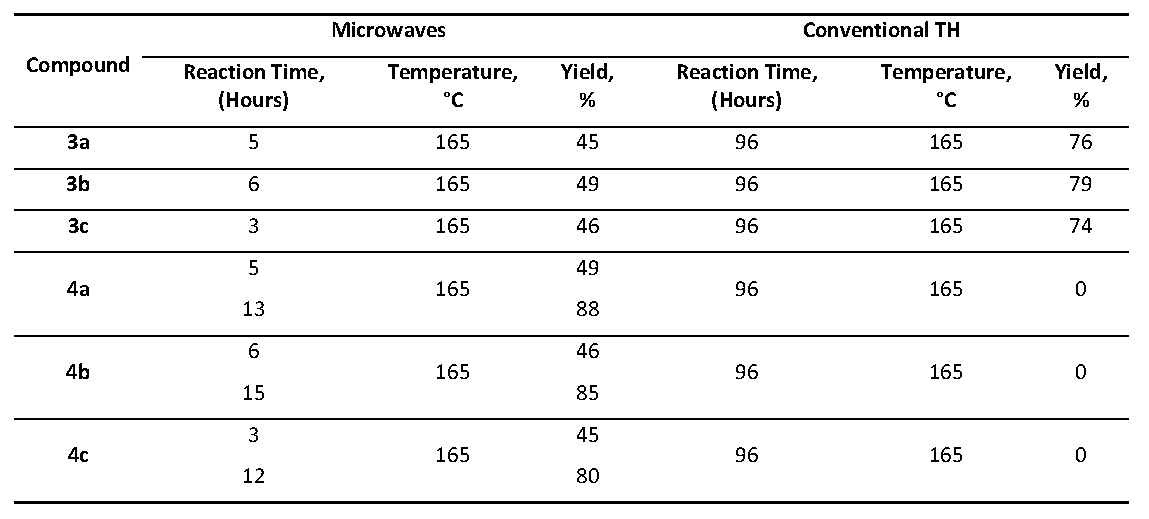
The data listed in Table 1 indicate that, when the reactions were carried out under TH conditions, a selective cyclocondensation reaction occurred, leading to the benzofuran ester derivative type 3a–c, in good yields (74–79%). Under MW irradiation, according to the reaction time employed, the reactions occurred differently. When MW irradiation was performed for a short period of time (3–6 h), a mixture of benzofuran derivatives (3a–c and 4a–c) was obtained in approximately equal proportions (around 95%). When MW irradiation was performed for a longer period of time (12–15 h), only one type of benzofuran derivative (3-methylbenzofurans (4a–c)) was obtained in a similar quantitative yield.
The structures of all new compounds were proven unambiguously by elemental and spectral analysis (IR, 1H NMR, 13C NMR, two-dimensional experiments 2D-COSY, 2D-HETCOR (HMQC), long-range 2D-HETCOR (HMBC).
All the studied benzofuran derivatives have emission spectra consisting of one structured band in the 305–370 nm region (Figure 1), indicating a planar structure of the molecules. The position of the band is significantly influenced by the presence of a carbomethoxy group at the 2 position of benzofuran ring.
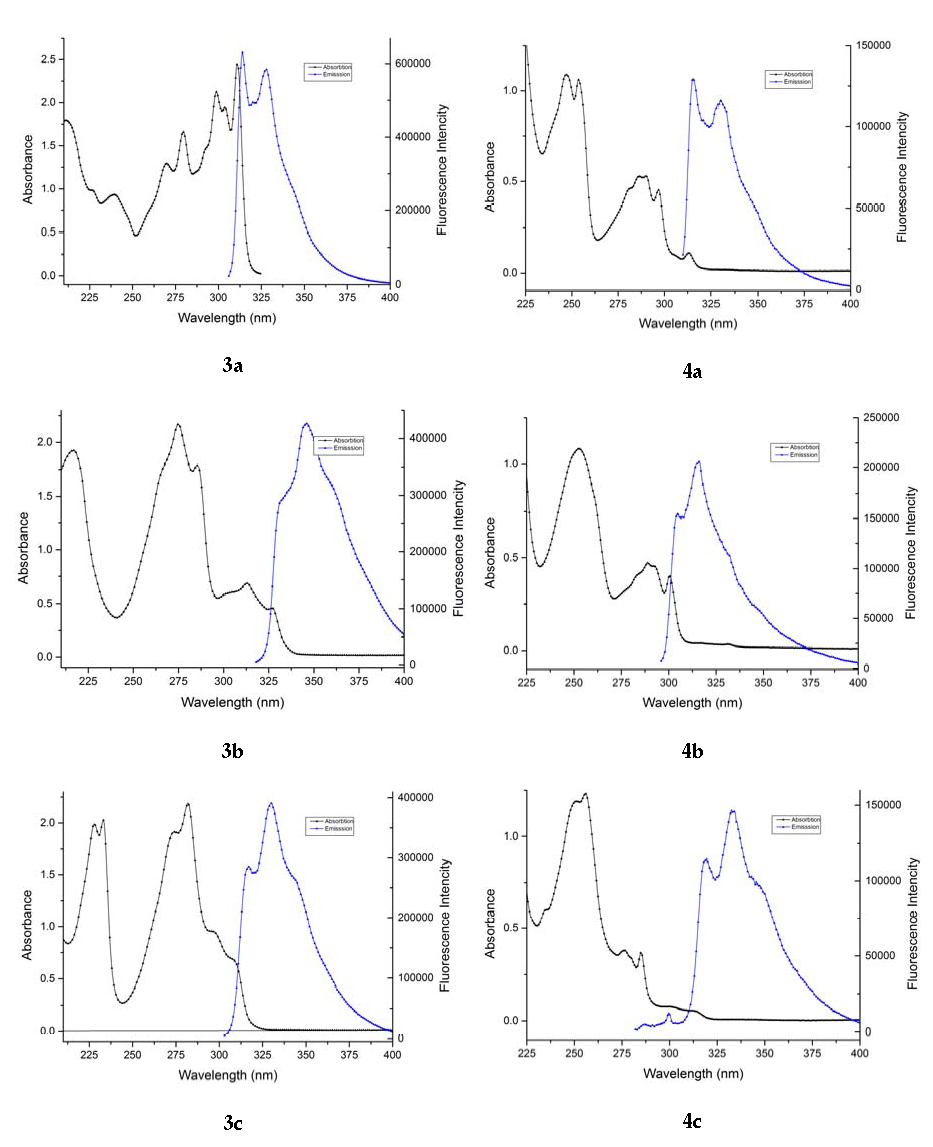
Figure 1. The absorption and emission spectra of benzofuran derivatives 3a–c and 4a–c in cyclohexane.
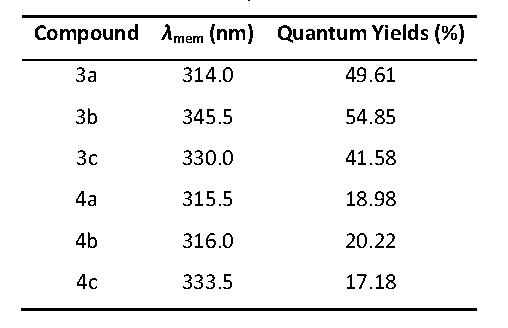
The fluorescence quantum yields of benzofuran derivatives are dramatically dependent on the presence of a carbomethoxy group in the furan ring. As seen in Table 3, compounds 3a–c have a high quantum yield (41–55%), while compounds 4a–c have moderate quantum yield values (17–20%).
Table 2. Fluorescence parameters: emission maximum wavelength, λmem and fluorescence quantum yield, of compounds 3a–c and 4a–c in cyclohexane.
I.1. Synthesis of benzo[f]quinolinium quaternary salts.
In this stage were synthesized some salts derived from benzo[f]quinoline 7a-h by quaternization reaction with halogenoderivatives with increased reactivity 6 such as haloketone. Benzo[f]quinolinium salts were obtained according to the literature data, using the classical heating sources.
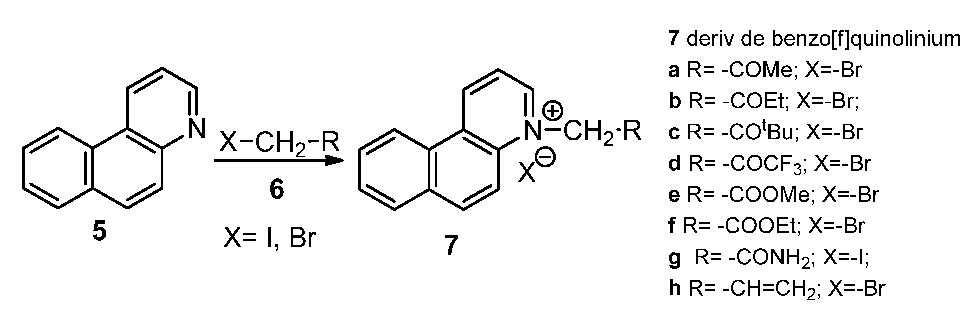
The corresponding benzo[f]quinoline salts were obtained with good to very good yields (between 75 and 90 %). The mainly disadvantage of this reactions is the long reaction time 96 hours, when the reaction solvent is acetone.
I.2. Synthesis of cycloimmonium salts by nonconventional method.
In order to reduce the reaction time we used an unconventional synthetic method – under microwave and ultrasound irradiation. The use of unconventional synthesis methods for these reactions had the main advantage of inducing a remarkable acceleration for reactions, the reaction times decreases dramatically, from 96 hours to 10 minutes by microwave irradiation and 30 minutes respectively by ultrasound irradiation. Also, in some cases, the yields are higher with up to 10%.
Table 3. Optimized reaction conditions.
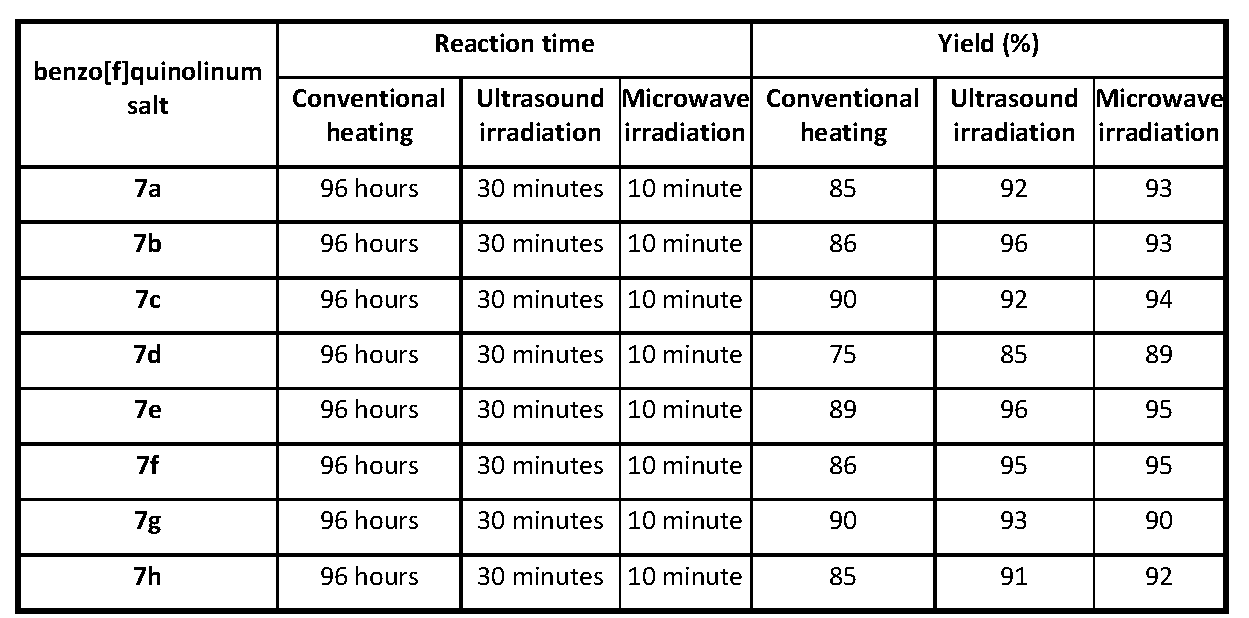
A new, efficient and general method for preparation of benzo[f]quinolinium salts via N-alkylation reactions using microwave and ultrasound irradiation was elaborated. By these procedures the reaction time decreases substantially, the yields are high and the reaction conditions are mild.
The structure of benzo[f]quinolinium salts was proven by elemental (C, H, N) and spectral analysis. The following spectroscopic methods were used: IR, 1H NMR, 13C NMR and two-dimensional experiments 2D-COSY, 2D-HETCOR (HMQC), long range 2D-HETCOR (HMBC). All the elemental and spectral data are in accordance with the proposed structure.
I.3. Synthesis of new penta- and hexacyclic azasteroids mimics.
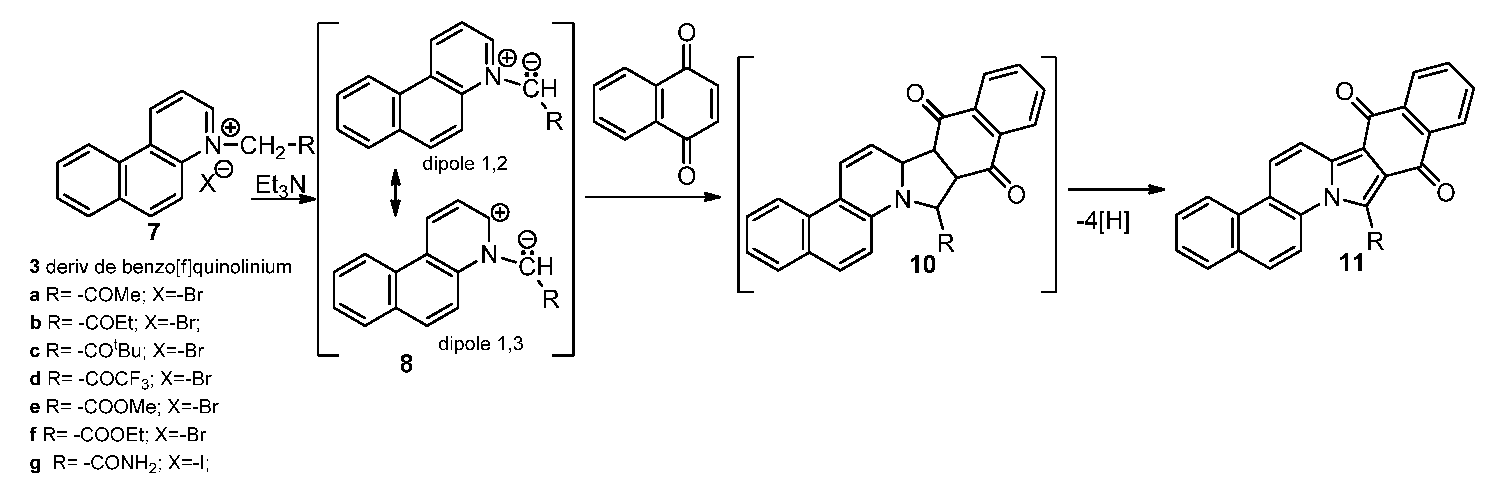
In this stage was investigated the reaction of of benzo[f]quinolinium N-ylides 8 (generated in situ from the corresponding quaternary salts 7) with activated alkenes. Reactions were performed using classical heating methods.
The cycloaddition reaction with N-phenyl maleimide led to obtaining the azasteroid pentacyclic structure.
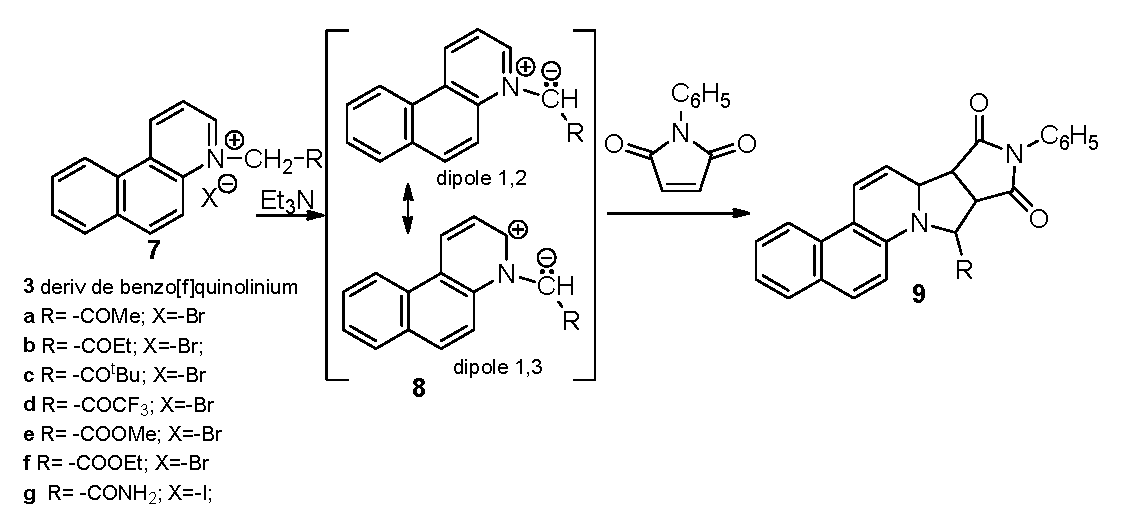
The [3+2] cycloaddition occurs highly stereospecifically and no formation of other regioisomers was obtained.
In the case of cycloaddition reaction with naphthoquinone, the tetrahydropyrolic intermediate type 10 was not isolated because it undergoes an oxidative dehydrogenation process and isolating the fully aromatic azasteroidic derivatives type 11.
The web site of the project can be found at: https://teclu.chem.uaic.ro/npamfb/. Here was published the final report of this stage.
I.4. A part of the obtained results were organized to be published in journals and presented on a series of national and international conferences as following:
One published paper :
Moldoveanu, C.; Mangalagiu, I.I.; Isac, D.L.; Airinei A.; Zbancioc, G.: A New Pathway for the Synthesis of a New Class of Blue Fluorescent Benzofuran Derivatives, Molecules, 23(8), 01968, 2018. DOI: 10.3390/molecules23081968. (Impact Factor 3.098)
4 papers presented on national and international conferences:
- Zbancioc, G.; Moldoveanu, C.; Zbancioc, A.M.; Tataringa, G.; Mangalagiu, I.: Effect of some new monoquaternary salts of benzo[f]quinoline on germination and seedling growth of norway spruce (picea abies (L.) Karsten), 1st International Conferance on “Agriculture, Forestry & Life Science”, 6-8 September, 2018, Budapest, Hungary (Poster presentation).
- Zbancioc, G.; Moldoveanu, C.; Antoci, V.; Amariucai-Mantu, D.; Mangalagiu, I.: Synthesis of new azasteroid derivatives with fluorescent properties, XXXV-th Romanian Chemistry Conferance, 2-5 October 2018, Calimaneşti-Caciulata, Valcea, Romania (Poster presentation P.S.I. 37).
- Moldoveanu, C.; Zbancioc, G.; Amariucai-Mantu, D.; Antoci, V.; Bejan, D.; Mangalagiu, I.: New ionic liquids with imidazole skeleton by anion metathesis, XXXV-th Romanian Chemistry Conferance, 2-5 October 2018, Calimaneşti-Caciulata, Valcea, Romania (Poster presentation P.S.I. 17).
- Zbancioc, G.; Moldoveanu, C.; Zvancu, M.A.; Ciobanu, C.; Antoci, V.; Mangalagiu, V.; Amariucai-Mantu, D.; Mangalagiu, I.: Synthesis of new pyrrolodiazine with fluorescent properties, IasiCHEM 2018 Faculty of Chemistry Conference, 25-26 October, 2018, Iasi, Romania(Poster presentation PI-23).
From the above it follows that all the objectives proposed for this stage were fulfilled in a proportion of 100%.
Project manager,
Associate professor PhD Gheorghita Zbancioc